Part I: Listen to the pod-cast
Storytelling: part I – show notes
Why are stories so important for selling?
When I’m working on a copywriting project, the first question I have to ask is: How aware are people of this product or service?

If they know what it’s all about, I can be really direct. I can say, “Our gasoline is 20% cheaper”, and people will come running.
But on the other end of that spectrum, if people have never stayed at your hotel and they’re wondering why it’s $40 more expensive than your competitor, you have to be indirect. You have to draw them in with a secret, a bold declaration… or a story.
The $1B promotion
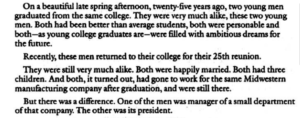
Let’s talk about why this worked so well.
- It focuses on the human condition, not the product
- We identify with the characters
- And we want to be the winner in this story
What could we steal from this for our hotel promotions?
We could make sure to:
- Focus on the human dynamics people experience while traveling (instead of the building)
- Identify specific emotions that people want to experience or avoid
- Offer a dramatic, memorable conclusion
Let’s start developing our own stories
Here are some good examples using the: I {do something} to {get something}: formula.
- I play piano to make friends:
“They laughed when I sat down at the piano… but when I started to play…”
This is the headline from a famous promotion by John Caples. This story helped him sell millions of dollars-worth of correspondence piano training courses.
- I go on cruises so my husband will pay attention to me again:
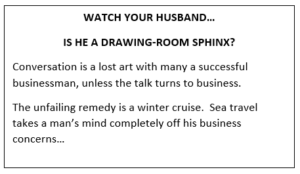
Do you see how this might have appealed to 1950’s era housewives? Do you see how it spoke to a deep emotion first and only mentioned the product later, as a way to enjoy the attention she desperately wanted?
- I live abroad to experience luxury at half the price of living at home:
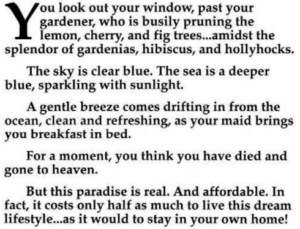
This was the promotion that Agora Publishing used to launch their flagship newsletter, International Living, 37 years ago. Since then, the success of this newsletter helped them build an enterprise with over 1 million paid subscribers and $500 million in revenues in 2015.
(How easy would it be for hotels to use story-telling copy like this for their own promotions!)
Time to develop a few stories of your own
Step 1: Fill this in by focusing on why people travel in your area and what they’re hoping to accomplish, emotionally.
For example, business men and women travel for business (of course), but the real reason they’re traveling may be to: 1. Take their careers to the next level, 2. Pay for their kid’s college, 3. Network, 4. Overcome a problem, etc.
Our millennial travelers travel to:_____________________________________
Our business travelers visit our area to:________________________________
Our married couples visit our area to:_________________________________
Senior citizens come to our area to:___________________________________
Families stay with us to:__________________________________________
Step 2: Can you think of any movies that have something in common with step 1? I’m sure you can think of more than one movie involving travel for adventure and romance. Make a short list to ‘get your creative juices flowing’.
Next week we’re going to be using this list to create a custom, 12-month social media marketing calendar that you can use to promote your hotel and destination.
By having a plan in place, you’ll be able to batch your work… so you can create a whole week of posts in a few hours… and you’ll be following a compelling story line, so you’ll be able to generate a lot more interest – and more direct bookings. Until then!
All the best,
Jeremiah
Loren Gray’s Podcast on Hospitality Digital Marketing
https://www.blubrry.com/hospitalitydigitalmarketing/17491226/show-123-of-tools-news-and-techniques-in-digital-marketing-for-the-week-of-september-30th-2016
Sign Up For Our
EMAIL NEWSLETTER
and receive this free guide: